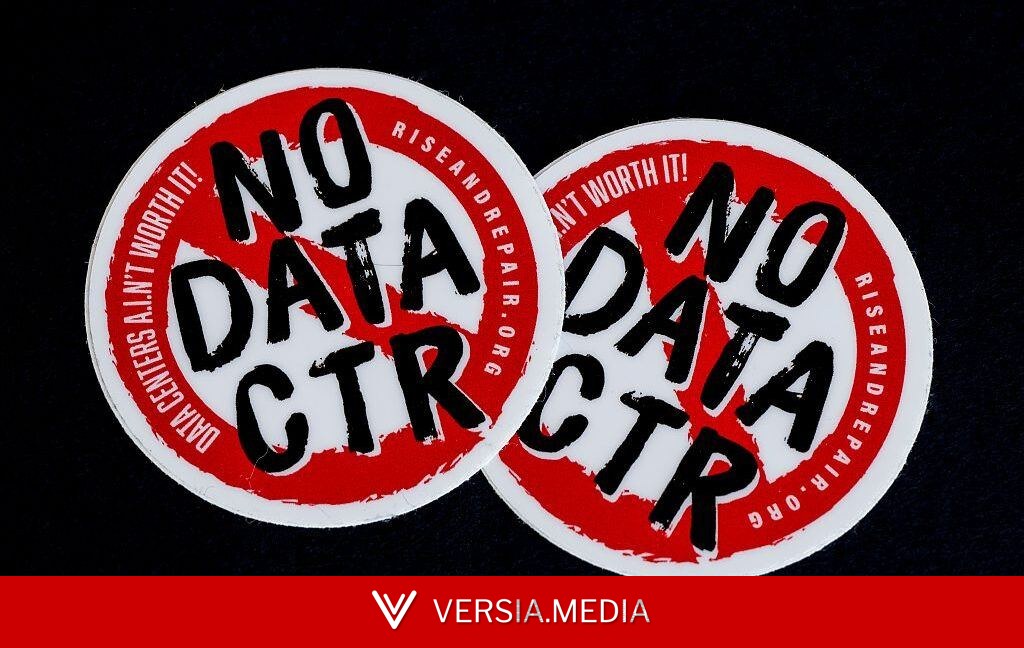
Winning fight against AI data centers gives people a “taste of political power.”
It is evident that communities now possess a proven strategy to halt data center construction. This week, researchers identified the first quarter of 2026 as the period with the “most blocked and delayed data center projects on record,” according to NBC News.
Data Center Watch, an initiative from AI intelligence firm 10a Labs that monitors data center conflicts across the United States, reported that protesters “blocked or delayed at least 75 projects nationwide worth about $130 billion from January through March,” NBC News noted.
This represents “the most in a three-month period since the group began tracking in 2023,” and should not be viewed as “a cyclical spike,” the researchers stated. Rather, there has been a “structural shift,” as “communities have internalized an opposition playbook, legislative sessions introduced formal regulatory uncertainty, and the number of active opposition groups more than doubled to 833 across 49 states,” the researchers said.
The political momentum behind data center protests is anticipated to shape the upcoming midterm elections, with both parties increasingly showing sympathy for resistance as opposition grows.
Sociologist’s unique take on data center opposition
Sociologist Tressie McMillan Cottom has been engaging with organizers in North Carolina to gain deeper insight into the playbook driving this momentum. In an op-ed for the New York Times urging Democrats to make data centers a central campaign issue, she wrote that she “wasn’t sold on data center resistance as a political possibility,” but “time on the ground changed my mind.”
Not only are individuals crossing political lines to oppose local construction projects, but people “are passionate enough to attend political education sessions about water rights, land use, and thermodynamics,” McMillan Cottom wrote. As she explained, individuals are not merely educating themselves to prevent noisy factories from raising utility costs, endangering public health, or depleting local resources; some are, for the first time, experiencing what it means to collaborate with neighbors to overcome hardship through political will:
“I have been watching this new groundswell of dissent firsthand in community meetings, organizing sessions and civic trainings here in North Carolina. The resistance has lifelong joiners, alumni from environmental and housing movements and young organizers. There are also a lot of people who have never dreamed of being disagreeable in public, much less considered joining a raucous social movement. The imminent risk of living next to a data center may be why they show up for a meeting, but they’re committing to the issue for bigger, deeper reasons. Political corruption and corporate malfeasance make them feel politically impotent. Voicing their objections, sharing their anxieties with others, recalling politicians who override them and in some cases beating the opposition is giving them something few politicians are offering—a taste of political power.”
“I have been watching this new groundswell of dissent firsthand in community meetings, organizing sessions and civic trainings here in North Carolina. The resistance has lifelong joiners, alumni from environmental and housing movements and young organizers. There are also a lot of people who have never dreamed of being disagreeable in public, much less considered joining a raucous social movement. The imminent risk of living next to a data center may be why they show up for a meeting, but they’re committing to the issue for bigger, deeper reasons. Political corruption and corporate malfeasance make them feel politically impotent. Voicing their objections, sharing their anxieties with others, recalling politicians who override them and in some cases beating the opposition is giving them something few politicians are offering—a taste of political power.”
Although it may be challenging for Democrats to craft a national message that capitalizes on anti-data-center sentiment, McMillan Cottom suggested that, if they could, it would be the “greatest untapped opportunity” to secure more electoral victories.
Data Center Watch noted that the record of $130 billion in data centers blocked or delayed in early 2026 nearly matched the total value recorded for all of 2025, approximately $156 billion. The researchers suggested that the latter half of 2025 marked a “turning point, as data center opposition emerged as a national-level narrative” that demonstrated the AI industry can no longer view these conflicts as isolated zoning disputes. It “is now reshaping elections, regulation, and site viability nationwide,” Data Center Watch reported last year.
For officials aiming to rapidly build data centers to advance America’s AI ambitions, confronting the escalating opposition as the playbook has solidified has proven difficult, NBC News reported. Whereas previously officials faced criticism for quietly signing agreements without consulting nearby residents, they now encounter backlash before any deal is finalized, Data Center Watch found.
“In some cases,” researchers reported, “opposition mobilized before any project was officially filed, the mere rumor of a data center was enough to trigger organized resistance.”
AI industry struggles to counter narrative
AI firms and data center developers, along with officials hoping to benefit from striking deals, are beginning to push back against data center hostility as effectively as possible.
Most recently, OpenAI released a report alleging that China was attempting to influence the US data center debate by using ChatGPT. OpenAI quickly banned the malicious actors, they reported, who were creating comics and memes to post on X, as well as generating social media comments, supposedly in an effort to sway US public opinion.
There has also been a push to characterize public dissent as “naïve,” McMillan Cottom noted, “or, worse, un-American.”
Proponents of data centers argue that debates over electricity price increases or water resources are based on misinformation. In a recent Atlantic article claiming “the data-center panic is overblown,” it is stressed that only drought-stricken locations or areas with strained power grids need to be concerned about these issues. And economists suggested that communities risk overlooking little-discussed long-term advantages, such as employment gains that “are likely to grow as new data centers attract businesses that use AI.”
In Loudoun County, Virginia, The Atlantic noted, 53 million square feet of data centers have been built over the past 20 years. Although data centers account for only about 3 percent of the county’s land area, they generate “almost half of its property-tax revenue—a projected $1.3 billion in 2026,” The Atlantic reported. While some data center projects were moved out of residential zones due to noise complaints, communities have largely benefited from allowing data centers in, with lower tax rates and more affordable housing.
This week, Meta claimed a similar data center public relations win in Louisiana. One of the tech giant’s data center projects more than doubled Richland Parish’s sales and use tax, leading some teachers to receive $50,000 bonuses, thanks to an ordinance that “lets the school board collect a 1 percent sales tax to fund teacher bonuses,” The Wall Street Journal reported. Scott Franklin, a director of the parish’s chamber of commerce and a farmer who sold the land to Meta for the data center, told WSJ that “anybody that complains about teachers getting a $50,000 check, they just instantly lose all credibility with me.”
But The Atlantic story appears to overlook one of the biggest complaints locals have about data centers: a lack of comprehensive environmental reviews. For the most part, communities simply do not want local officials to take the kind of shortcuts to speed up data center approvals that Donald Trump and other Republicans have called for.
In Illinois, Governor J.B. Pritzker is urging lawmakers to develop a legislative framework for responsible data center development in the state, with proper environmental reviews at its core. And other cities, counties, and states are shifting to provide residents with more information as deals are increasingly obstructed by residents loudly voicing opposition. Most recently, a data center developer in Utah pledged to handle all communications personally to make his construction project more transparent, after backlash reduced the total approved land area for the site by 50 percent.
Dems slow to embrace data center resistance
McMillan Cottom suggested that no public officials on the right or the left have perfected their messaging to align with anti-data center sentiments. Money may be what stands in the Democrats’ way of fully embracing the data center resistance, she suggested, as many AI firms are donating hundreds of millions to campaigns to influence elections.
Massachusetts Sen. Elizabeth Warren’s plans to tax AI firms to compel more transparency are “wonky,” she said. And Sen. Bernie Sanders’ call for Americans to profit from AI—which Trump, to some degree, agrees with—depends on creating a wealth fund that at least one critic warned “would enshrine the tech sector’s as-yet-unproven claims of its importance.”
Perhaps Rep. Alexandria Ocasio-Cortez has come closest to tapping into the nationwide anger. After joining Sanders in calling for a nationwide data center moratorium in March, she used jars she claimed were filled with dirty data center water to pressure the Environmental Protection Agency over its alleged failures to investigate a Meta project in Georgia.
Meta has denied that its Georgia data center is polluting waters. But analysts think that Ocasio-Cortez’s instinct to use the jars to symbolize data center opposition seems more likely to strike a chord and generate support than even the most sincere efforts to regulate or tax data centers, as long as the long-term harms of construction remain unknown and the risks of AI stay abstract.
The Atlantic’s piece concluded that the “reasons for resisting data centers may ultimately have less to do with the tangible costs than the symbolic ones.”
Along similar lines, McMillan Cottom suggested that “the voters showing up to fight data centers demonstrate that a lot of us want something different.” And what many politicians and AI enthusiasts perceive as a wave of unsubstantiated backlash is actually “the righteous rage driving millions of Americans to look up from their enemy and finally see, instead, a neighbor and future worth fighting for,” she wrote.