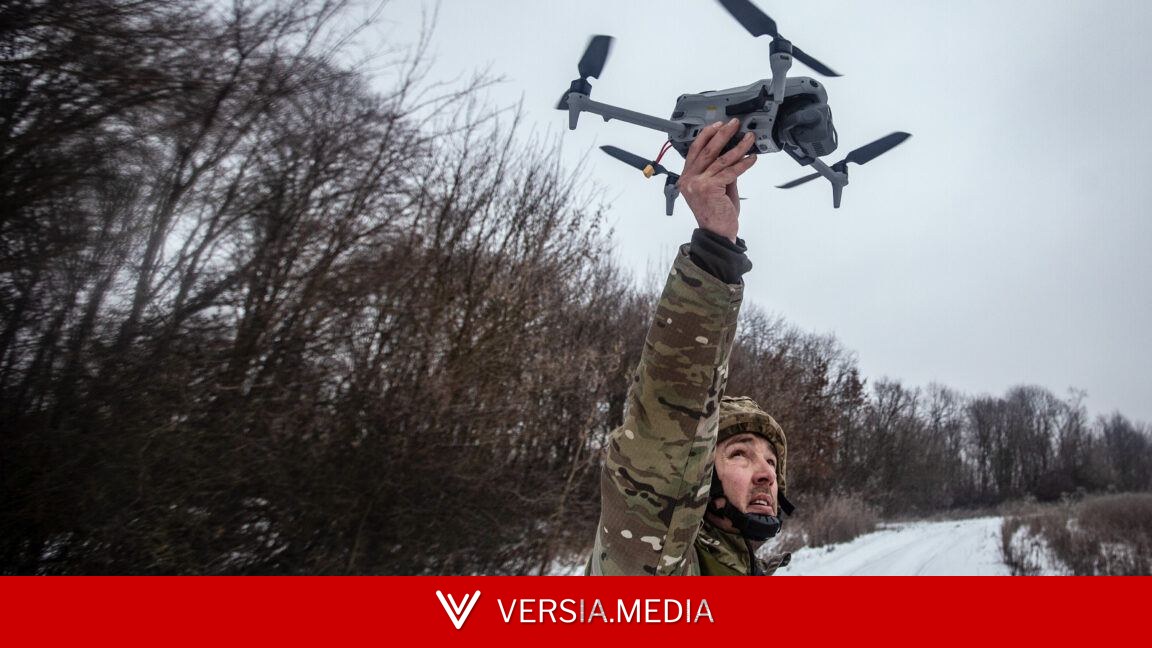
Full autonomy is uncommon, yet Ukraine is integrating AI modules into drones and robotic systems.
Fully autonomous drones eliminated Russian soldiers during a field test two years ago, as claimed by a Ukrainian drone manufacturer. If accurate, this event would signify another achievement in a conflict that has driven extraordinary advancements in military drones, robots, and AI-directed weaponry.
The singular test was disclosed by Alexander Kokhanovskyy, CEO of the Ukrainian drone firm Aero Center, during a conversation with New Scientist at a press gathering hosted by the Ukrainian embassy in London. Kokhanovskyy detailed the test—which did not involve his current company Aero Center—employing quadcopter drones that were preprogrammed to navigate to a frontline zone before triggering an AI-driven “Terminator mode” designed to locate and assault any target within that designated area.
Apparently, there was no video feed or other evidence to indicate what the “Terminator” drones targeted and struck. However, Kokhanovskyy informed New Scientist that human-operated drones dispatched to assess the aftermath discovered “a couple” of deceased Russian soldiers, leading to the inference that the fully autonomous drones had caused their deaths.
Representatives from defense firms at the Ukrainian embassy gathering stated that the Ukrainian government prohibits the use of AI during the final stage of target engagement, as reported by New Scientist. Additionally, a Ukrainian military commander told New Scientist that his drone pilots exclusively utilize semi-autonomous systems where humans always make key control decisions. He highlighted Ukraine’s dedication to “international humanitarian law” while stressing that the military consistently exercises “great care in decision-making in order to prevent civilian casualties.”
The one-off nature of this trial is understandable given the practical constraints of this method, as well as concerns related to international humanitarian law. Deploying fully autonomous drones to attack any and all targets within a specified zone without any human operator oversight demands meticulous preplanning and carries the danger of so-called “friendly fire” incidents or strikes on civilian non-combatants. It is also uncertain how effective these fully autonomous quadcopter drones were at selecting and engaging targets compared to human drone pilots.
Currently, there is no universally accepted definition of what constitutes a lethal autonomous weapon system, according to the United Nations Office for Disarmament Affairs. However, common descriptions characterize weapon systems with the autonomy to “perform their functions in the absence of direction or input from a human actor.” US Department of Defense policy has defined lethal autonomous weapons as “weapon system[s] that, once activated, can select and engage targets without further intervention by a human operator.”
The function of autonomous AI in drone arsenals
Fully autonomous weapons capable of “accomplishing goals independently or with minimal supervision in complex and unpredictable environments” are not yet a battlefield reality in the war in Ukraine, according to Kateryna Bondar, a former advisor to the Ukrainian government, in her report for the Center for Strategic and International Studies (CSIS) think tank in Washington, DC. Yet she emphasized a rising number of drones incorporating certain autonomous capabilities for navigation and occasionally targeting, even though human operators retain overall command.
Ukraine and Russia are deploying numerous FPV drones for reconnaissance and attacking vehicles and even individual soldiers. These are usually operated by trained drone pilots who use virtual-reality goggles to view the drone’s perspective while aiming at enemy targets. There are also larger quadcopter or multirotor “bomber” drones that can transport heavier loads for either supply missions or dropping explosives on enemy positions at the front lines.
Longer-range strike drones resembling fixed-wing aircraft may integrate more autonomous decision-making features. In 2025, Russia launched hundreds of drones nightly to attack Ukrainian cities, including Shahed drones initially supplied by Iran and increasingly produced in Russia. Shahed drones are typically preprogrammed to fly automatically toward their targets with limited autonomous decision-making ability. However, some Shahed drone versions, such as the Geran-2, are fitted with smuggled Nvidia Jetson Orin microcomputers that enable onboard video processing and autonomous decision-making functions, including autonomous target recognition and re-targeting.
To defend against those assaults by Russian Shahed drones, Ukraine has deployed low- and high-tech air defense systems that include domestically produced, low-cost interceptor drones. Some interceptor drone systems are engineered to autonomously fly to the interception point and lock onto targets—though a human operator is still needed to perform initial target selection and initiate strike commands while always retaining the ability to cancel attacks, according to the Ukrainian government platform United 24.
Meanwhile, Ukraine has achieved the technological and manufacturing capacity to launch over 5,000 drone strikes against Russian targets at ranges exceeding 20 kilometers each month, as per the Ukrainian Ministry of Defense. These mid- and long-range strike drones heavily depend on autonomous navigation capabilities due to Russian electronic warfare systems that can disrupt human operator communication links, along with GPS jamming that can misdirect GPS-guided weapons. Such AI-driven navigation has increased the success rate of Ukrainian drone strikes from roughly 10 to 20 percent to 70 to 80 percent, Bondar wrote in her CSIS report.
Overall, Ukraine’s defense sector has concentrated on training small AI models on limited datasets to operate on the constrained computing power of small and inexpensive chips, Bondar noted. That strategy has produced AI-driven software for essential autonomous functions—including navigation and target recognition—that can be bundled with standalone hardware modules for installation on small first-person view (FPV) drones, long-range strike drones, or even the gun turrets of uncrewed ground robots. Thus, even if fully autonomous systems remain scarce, anticipate more drones and robots gaining specific autonomous AI capabilities that supplement human decision-making on the battlefield.
This story was updated on June 12 to include more information on Ukraine’s current policy against using such fully autonomous drones, and to clarify that Kokhanovskyy’s company Aero Center was not involved in the one-time field test of the technology.