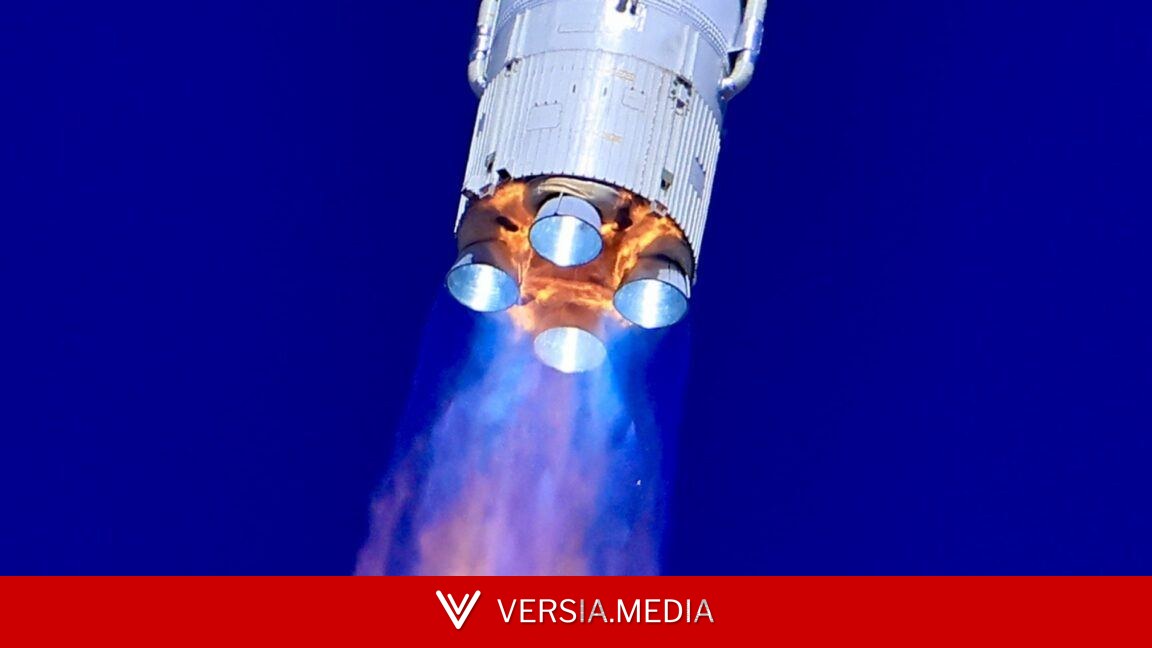
The disintegration of the rocket is estimated to have produced between 100 and 150 new fragments of space debris.
The upper stage of a commercial Chinese rocket, which launched last week, has disintegrated in orbit, scattering debris across a busy section of low-Earth orbit that houses the International Space Station and a substantial portion of SpaceX’s Starlink broadband network.
The fragmentation occurred shortly after the Zhuque-2E rocket reached orbit on June 9, carrying two satellites for direct-to-cell communications, potentially around the time the upper stage was scheduled to execute a disposal burn. The U.S. Space Force confirmed the breakup event in a post on space-track.org, a platform the military uses to share orbital data with the public.
“The tracked pieces are being incorporated into routine conjunction assessment to support spaceflight safety,” the Space Force stated in an advisory. “There are currently no threats to human spaceflight. Analysis is ongoing.”
Quantifying the fragments
As of now, the Space Force has not yet added any of the debris pieces to the official catalog of human-made objects in space. Darren McKnight, a senior technical fellow at the orbital intelligence firm LeoLabs, informed Ars that the fragmentation event likely produced 100 to 150 debris fragments.
In one instance, the second stage of the Zhuque-2E rocket, manufactured by the Chinese company LandSpace, measured between 25 and 30 feet (roughly 8 meters) in length and 11 feet (3.35 meters) in diameter. The primary body of the rocket’s upper stage is currently orbiting at an altitude ranging from 208 miles to 263 miles (335 by 424 kilometers), with an inclination of 54.5 degrees relative to the equator.
The highest point of this orbit intersects the path of the International Space Station, though aerodynamic drag will swiftly pull all debris fragments below the ISS. The debris could present a greater hazard to hundreds of Starlink satellites, especially those offering direct-to-device connectivity and recently launched satellites, which operate at lower altitudes than the majority of the Starlink constellation.
The positive aspect is that this altitude is low enough for aerodynamic drag to cause most of the Zhuque-2E debris to reenter the atmosphere within a few months. The majority of the material will incinerate upon reentry. The worst-case scenario involves a debris-generating event above 400 miles (650 kilometers), where it could take decades or longer for an object to naturally descend back into the atmosphere.
The downside is that the Zhuque-2E’s disintegration represents the latest instance of China’s escalating role in the space debris problem. After decades of abandoning spent rocket bodies in orbit, launch operators in most nations now reserve sufficient fuel to guide their upper stages back to Earth for controlled reentries. Rocket bodies linked to Russia and the former Soviet Union account for the majority of launch-related debris in long-lasting orbits, followed by China and the United States.
However, the Russian and American figures are declining or stabilizing, while the mass of Chinese rocket bodies in these enduring orbits has surged by more than 150 percent over the past five years, according to a recent analysis by Space Domain Awareness expert Jim Shell. This rise coincides with China’s increased launches of its own megaconstellations, intended to rival SpaceX’s Starlink. Ars reported on these figures last month.
Rocket bodies are among the most worrisome sources of space debris due to their typically large size and mass, often containing residual propellant and high-pressure gases that can trigger explosions. Once left abandoned in orbit after releasing their payloads, there is no method to maneuver or dispose of them.
McKnight described the recent breakup of the Zhuque-2E rocket as a “slight space safety issue,” but the trend is concerning. China’s Long March 6A rocket has a notably poor history, including two explosions that scattered over 1,000 debris fragments in a higher-altitude low-Earth orbit, where they will persist for decades or centuries.
“Three of the top four breakup events in LEO are of Chinese origin, with two of these events being from Chinese (rocket body) explosions in the last four years,” McKnight said.