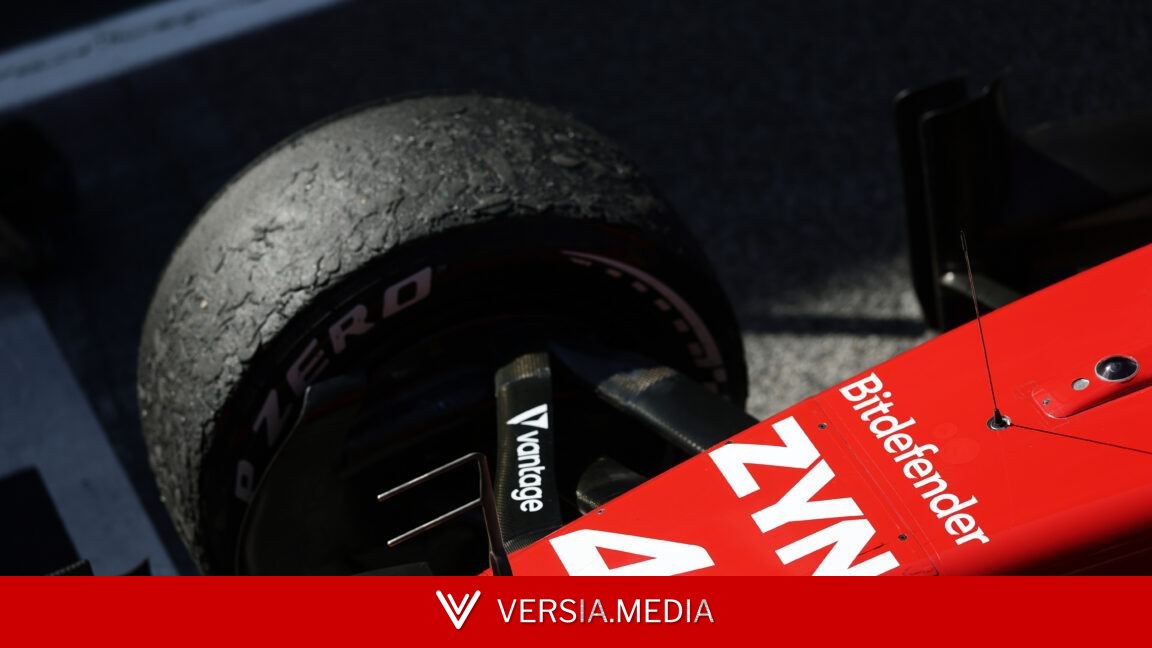
Equipped with a substantial package of new upgrades, Ferrari arrived in Spain brimming with self-assurance.
Formula 1 held its race in Spain over the weekend. The Barcelona-Catalunya circuit ranks among F1’s specially constructed racing venues, featuring numerous high-speed curves and a track surface that is more coarse than typical. This makes downforce the key priority. Catalunya has always demanded strong aerodynamics, but this is now twice as crucial. The greater the speed maintained through a bend, the less energy required on the subsequent straight, and energy management has become as vital in F1 as it is at Le Mans, in Formula E, or even in IndyCar. Moreover, increased downforce reduces sliding, and less sliding means less tire degradation.
It was the tire wear that pointed toward the strategies. Up to this point, every race this season has involved a single pit stop, as drivers complete their mandatory switch from one tire compound to another. However, 66 laps at Catalunya would demand at least three sets of Pirelli tires to finish. Possibly even four. As tires degrade, they become slower, losing roughly 0.2–0.3 seconds per lap. One method to take advantage of this is the "undercut"—pitting early, switching to fresh rubber, and capitalizing on the tire advantage over rivals to post rapid laps while they lose time. Execute it correctly, and by the time they make their next stop, you should be ahead.
Breaking the race into four segments means an additional pit stop, which costs around 22 seconds to travel through the pit lane, halt in the box, and exit again, assuming a tire change in under three seconds. However, because each set of tires is used for fewer laps, they can be pushed hard enough to compensate for that 22-second stop and more.
Bold strategies like that don’t always pay off; the two-stop plan chosen by most teams was the safe, prudent route. But Ferrari didn’t play it safe. It arrived in Spain with a heavily upgraded car—new front wing, new floor, new sidepods, and more. It likely already possessed the best chassis on the grid, and unlike a couple of years ago, the upgrade it introduced in Spain performed well, particularly when piloted by a newly revitalized Lewis Hamilton.
Still got it?
The seven-time World Champion experienced a significant dip in performance with the arrival of ground effect cars in 2022. Those vehicles generated downforce mainly through the shape of their underfloor (rather than wings and diffuser) and featured very restricted suspension setups. It’s fair to say Hamilton never adapted to them. The previous year, he had secured eight wins, bringing his career total to 103. He didn’t win a single race in 2022 or 2023, though he did claim victory at the British Grand Prix in 2024, then inherited the win in Belgium two races later after George Russell was disqualified post-race.
In 2025, Hamilton left Mercedes, where he had earned six of his seven championships, to take on the challenge of racing for Ferrari. Yet his results in the ground effect Ferrari were even worse than those in the ground effect Mercedes, and by the season’s end, many critics were questioning whether it was time for the driver to retire.
The 2026 car suits Hamilton much better. It is smaller, lighter, and more agile, and the ground effect-generating floors are gone. It aligns far more with his driving style, which involves late, heavy braking before rotating the car at the corner apex. This is even more true after he convinced team management that it was worth disrupting long-term partner Brembo—a relationship spanning over 50 years—to switch to his preferred brake pad supplier, Carbon Industrie.
Bolstered by second-place finishes in both Canada and Monaco, Hamilton appeared somewhat lost during the second of Friday’s two practice sessions, having given up his car in the first for Ferrari junior Dino Beganovich. However, on Saturday, Hamilton was far more comfortable in the car and missed out on pole position to his former Mercedes teammate Russell by less than a tenth of a second.
Despite Hamilton’s qualifying performance, conventional wisdom still favored the silver Mercedes cars as the front-runners. Kimi Antonelli qualified third, fresh off yet another win at Monaco, but Leclerc’s Ferrari was in 10th following a crash, unable to support his teammate—or challenge for the lead himself—at the race’s start. Mercedes appears to have neutralized Ferrari’s starting advantage; in Canada, Monaco, and now Spain, its cars were very quick when the lights went out.
The right call
Hamilton began on soft tires, unlike the medium-shod cars around him, and committed to the three-stop early, pitting on lap 11. He immediately began exploiting the tire advantage effectively, and, observing his sector times, other teams called their drivers to the pits in response. Russell stopped on lap 12 and stayed ahead of Hamilton, who pitted again on lap 27. Russell maintained the lead until his second stop on lap 36, battling with his own teammate Antonelli until then, with the pair losing time hand over fist to Hamilton. Antonelli stopped from the lead on lap 37, at which point Hamilton took first place and held it until the end.
His third stop should have set up the prospect of watching him have to battle past Lando Norris’ McLaren and then both Mercedes, albeit with enough of a tire offset to most likely make his way back to the lead. But fate made things a little simpler. Fernando Alonso’s Aston Martin stopped on track, and the virtual safety car period lasted just long enough for Hamilton to get in and out of the pits without losing a position. Rather than slowing down and cruising to a win, Hamilton maintained his pace, finishing almost 20 seconds ahead of Russell.
Russell has been on the back foot lately after all of Antonelli’s wins, often due to reliability issues, but in Spain, it was his turn to benefit from what looks like an increasingly unreliable Mercedes power unit. Antonelli had actually just managed to pass Russell on track on lap 61 before grinding to a halt a lap later. Ferrari’s power unit is much more reliable, but this weekend, its hydraulics weren’t, costing Leclerc a race finish.
Antonelli’s DNF has reduced his title lead to just 41 points ahead of Hamilton, with Russell in third. Given Ferrari’s speed at a track like Catalunya and better reliability, it might be time to start considering Hamilton as a genuine contender.