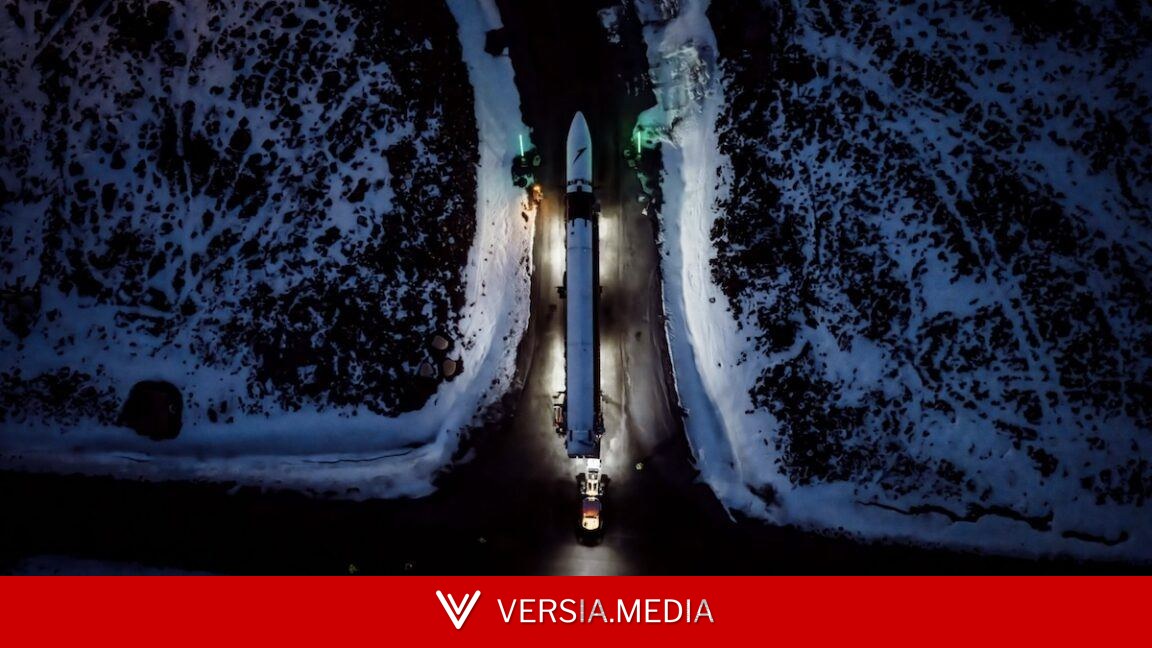
Isar Aerospace may not be short on funding, but it is critically lacking in flight experience.
Isar Aerospace still holds the leading position among a new wave of European rocket startups, yet the company continues to face obstacles in its attempts to launch a crucial test flight of the Spectrum rocket.
The most recent setback occurred on Monday, when Isar called off a launch attempt after "detecting off nominal behavior in the vehicle’s fluid systems," as stated in a social media update. "The teams are analyzing the new data to isolate the root cause."
The two-stage, 92-foot-tall (28-meter) Spectrum rocket was poised for liftoff from Andøya Spaceport in northern Norway. This marked the fourth time in five months that Isar Aerospace, headquartered near Munich, Germany, had reached a targeted launch date for the second test flight of the Spectrum vehicle.
Andøya Space, the company that operates the launch site, noted on its website that the current launch window extends through June 21. Isar did not immediately provide a new timeline for launching the second Spectrum test flight.
Gravity still winning
The Spectrum rocket has missed three launch windows so far this year. Isar aborted a launch attempt on January 21 due to a problem with a pressurization valve, and later halted a countdown on March 25, just before liftoff, when engineers detected rising temperatures in the rocket’s liquid propane fuel. Isar officials attributed the issue to a delay earlier in the countdown caused by an unauthorized boat in restricted waters along the rocket’s flight path.
Managers stood down from another launch attempt on April 9 to investigate a suspected leak in a composite overwrapped pressure vessel. That led to Isar’s most recent effort to launch the Spectrum rocket on Monday.
"Scrubs are part of the business," Isar founder and CEO Daniel Metzler said in April. "Each attempt gives us valuable experience and lessons learned."
This sentiment will resonate with anyone who follows rocket launches casually. However, launch availability is proving to be a challenge at Andøya Spaceport. The remote facility is frequently used as a military testing range. That was the case last month, when missile testing took precedence at the base inside the Arctic Circle, according to local media reports.
Andøya’s location near a rich offshore fishery has also created friction. The skipper of the longline fishing boat that was within the launch hazard area during Isar’s March launch attempt told local media he remained in the keep-out zone to retrieve tangled gear. He also refused to leave the area where a German bombing exercise was scheduled to take place last October, but denied any accusations of sabotage.
The test range is a key component of Norway’s military partnership with Germany. Olafur Einarsson, captain of the fishing vessel, advocated for local interests in an interview with the newspaper Kyst og Fjord: "For us fishermen, this is our workplace, and then they come here and want to use the same area. We have gotten a bad neighbor, you could say."
Tension between the launch and fishing industries is not a new phenomenon. In the early days of Japan’s space program, launches from the country’s primary spaceport were restricted to certain months based on fishing seasons near Tanegashima Island. Those limitations persisted for decades until an agreement in 2010 allowed for year-round launches.
Isar Aerospace leads a group of emerging European rocket companies aiming to make the continent’s once-dominant commercial launch industry competitive again. Several other firms—including Germany’s Rocket Factory Augsburg, France’s MaiaSpace, and Spain’s PLD Space—are developing their own small satellite launchers to offer a lower-cost alternative to Arianespace and Avio, Europe’s established launch providers.
Isar’s Spectrum rocket is the only one that has flown on a test mission. The rocket’s first launch in March 2025 lasted less than a minute before crashing near the launch pad. Engineers identified the unintentional opening of a vent valve and a loss of attitude control as the cause of the failure.
There were no customer payloads aboard the failed Spectrum launch last year. This time, Isar has placed five small CubeSats and a non-separating technology experiment inside the Spectrum rocket’s payload fairing. The second test flight is backed by the European Space Agency’s "Boost!" program and the German Aerospace Center’s Microlauncher Competition, which provide funding for commercial space transport initiatives.
Isar Aerospace is set to receive up to 205 million euros ($238 million) from ESA through the European Launcher Challenge program, supplementing the company’s private fundraising and financing rounds totaling more than 800 million euros (nearly $1 billion), including 270 million euros ($313 million) announced just last week. This makes Isar, by a wide margin, the most well-funded private launch company in Europe.
Isar may not be hurting for money, but it is sorely lacking in the currency of flight experience. When it finally occurs, the next launch will aim to address that issue.